Jan Weinschenker
Side-by-Side: Reactive vs non-reactive Java
#1about 6 minutes
Understanding the core principles of the reactive manifesto
Reactive systems are designed to be responsive, elastic, and resilient by using a message-driven architecture.
#2about 2 minutes
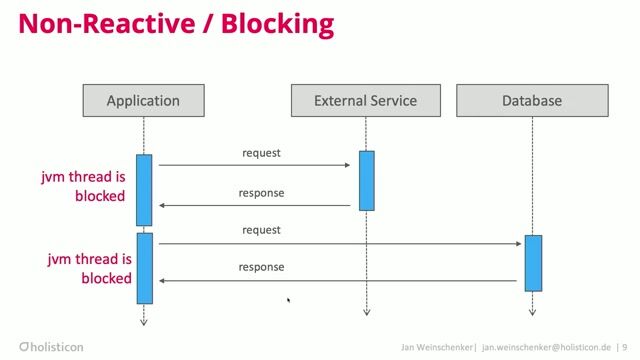
Visualizing blocking vs non-blocking request models
Sequence diagrams illustrate how non-blocking, fire-and-forget requests improve resource utilization compared to traditional blocking calls.
#3about 3 minutes
An analogy for reactive task distribution
A story about cleaning rooms illustrates how reactive programming breaks large workloads into small, independent tasks for efficient parallel execution.
#4about 2 minutes
Exploring reactive Java frameworks and adoption challenges
Despite numerous frameworks like WebFlux and RxJava, reactive programming faces a steep learning curve and debugging complexities.
#5about 3 minutes
Live code demonstration of imperative Java
A walkthrough of a standard, non-reactive Java method shows a straightforward, blocking approach to fetching and processing API data.
#6about 3 minutes
Live code demonstration of reactive Java
The same API data fetching task is implemented using a reactive, stream-based approach with Spring WebFlux and Project Reactor's Flux.
#7about 3 minutes
Understanding the unique reactive debugging experience
Debugging reactive code reveals its declarative nature, where execution is non-linear and only begins after a subscription is made.
#8about 3 minutes
Q&A on Project Loom and integration challenges
The discussion covers whether Project Loom makes reactive programming obsolete and how to handle integration with non-reactive components like JDBC.
Related jobs
Jobs that call for the skills explored in this talk.
tree-IT GmbH
Bad Neustadt an der Saale, Germany
€54-80K
Intermediate
Senior
Java
TypeScript
+1
Picnic Technologies B.V.
Amsterdam, Netherlands
Senior
Java
Amazon Web Services (AWS)
+1
Matching moments
Featured Partners
Related Videos
Java's Project Loom & Co - the end for reactive programming?
Jan Weinschenker
Going reactive with Spring WebFlux
Michael Eder & Philipp Frauenthaler
Is reactive the new black? Imperative vs. reactive programming with Quarkus
Tatiana Chervova
Slip Through the Boundaries of Legacy Systems with Kotlin and Spring WebFlux
Lukas Georgieff & Alberto Gisbert
Development of reactive applications with Quarkus
Niklas Heidloff
Bringing back reactivity in "reactive" frontend
Michał Moroz
The Rise of Reactive Microservices
David Leitner
Java with a Clojure mindset
Dan Lebrero
Related Articles
View all articles

.gif?w=240&auto=compress,format)

From learning to earning
Jobs that call for the skills explored in this talk.


Reversinglabs
Senior
CSS
React
Django
Python
Docker
+3

AgileEngine
Barcelona, Spain
Remote
Intermediate
Java
React
TypeScript
Microservices


CodeCamp:N GmbH
Nürnberg, Germany
Intermediate
Azure
React
Spring
Angular
Project Management
+1
![Full Stack Software Engineer"}}]},{"@context":"https://schema.org/","@type":"JobPosting","@id":"#jobPosting","title":"Senior Full Stack Software Engineer](https://wearedevelopers.imgix.net/public/default-job-listing-cover.png?w=400&ar=3.55&fit=crop&crop=entropy&auto=compress,format)
Reversinglabs
Senior
CSS
React
Django
Python
Docker
+3