









BB
Benedikt Bischof
WeAreDevelopers LIVE
•
May 26, 2021
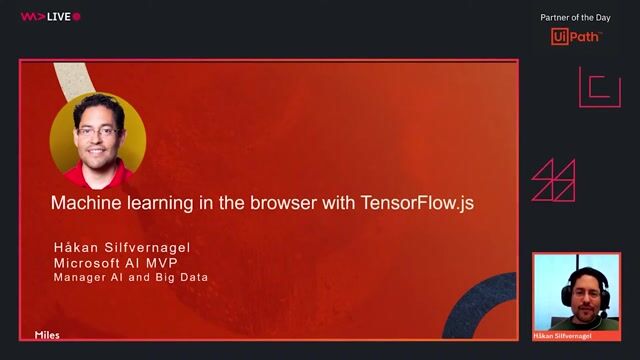
Machine learning in the browser with TensorFlowjs
Håkan Silfvernagel
- Discuss this with your agent
- Open in Claude
- Open in ChatGPT
Want to build privacy-first AI without learning Python? Discover how to train and deploy machine learning models directly in the browser using TensorFlow.js.
Matching moments
1:20 min
Introduction to TensorFlow.js for browser machine learning
 Alexandru Hang · Europe 2026 Virtual
2:36 min
Implementing and training the prediction model in TensorFlow.js
Eliran Natan · LIVE
2:46 min
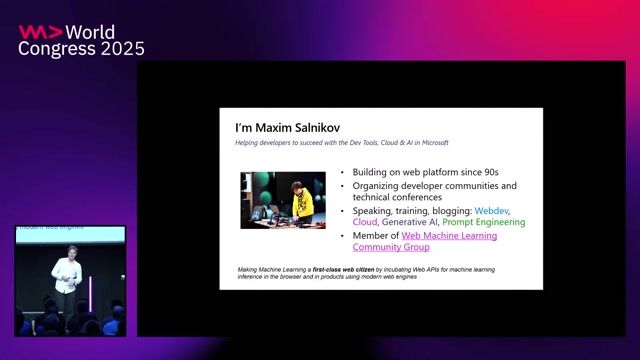
The case for native AI in web browsers
 Maxim Salnikov · World Congress 2025
3:36 min
Exploring machine learning and image classification in JavaScript
 Carly Richmond · World Congress 2025
7:51 min
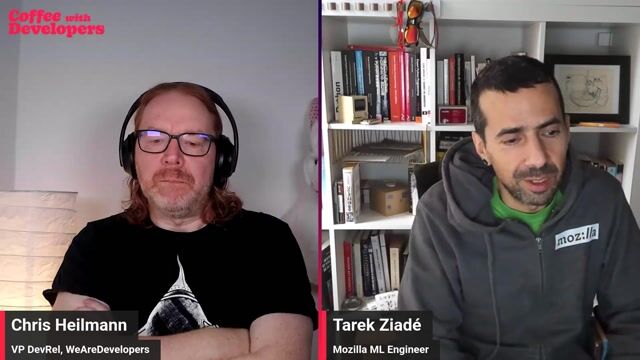
Integrating embedded machine learning models into the Firefox browser
 Chris Heilmann +2 · LIVE
2:17 min
Accelerating local machine learning models via WebNN
 Christian Liebel · World Congress 2026 Europe
More from WeAreDevelopers LIVE
Related videos
Related articles
.gif)
BB
Benedikt Bischof
.gif)
DC
Daniel Cranney

CH
Chris Heilmann

From learning to earning
Jobs that call for the skills explored in this talk.
26 days ago
•
Verified
Staff Machine Learning Engineer

Arm
Austin, United States
Experienced
$249k–338k
Remote
Python
TensorFlow
7 days ago
Staff Machine Learning Engineer
ARM
Austin, TX, United States
Experienced
$249k–338k
Pytorch
Tensorflow
Deep Learning
about 2 months ago
Senior AI Frontend Engineer

TeamViewer Germany GmbH,
Austin, TX, United States
Expert
ReactJS
TypeScript
Material UI
about 1 month ago
Machine Learning Engineer

Twilio
United States
Experienced
Remote
Spacy
Pytorch
Chatbots
about 1 month ago
•
Verified
LLM Training Engineer

Sciforium
San Francisco, United States
Expert
$155k–220k
Python
about 1 month ago
•
Verified
Software Engineer, Fullstack
Sciforium
San Francisco, United States
Expert
$165k–210k
Python